
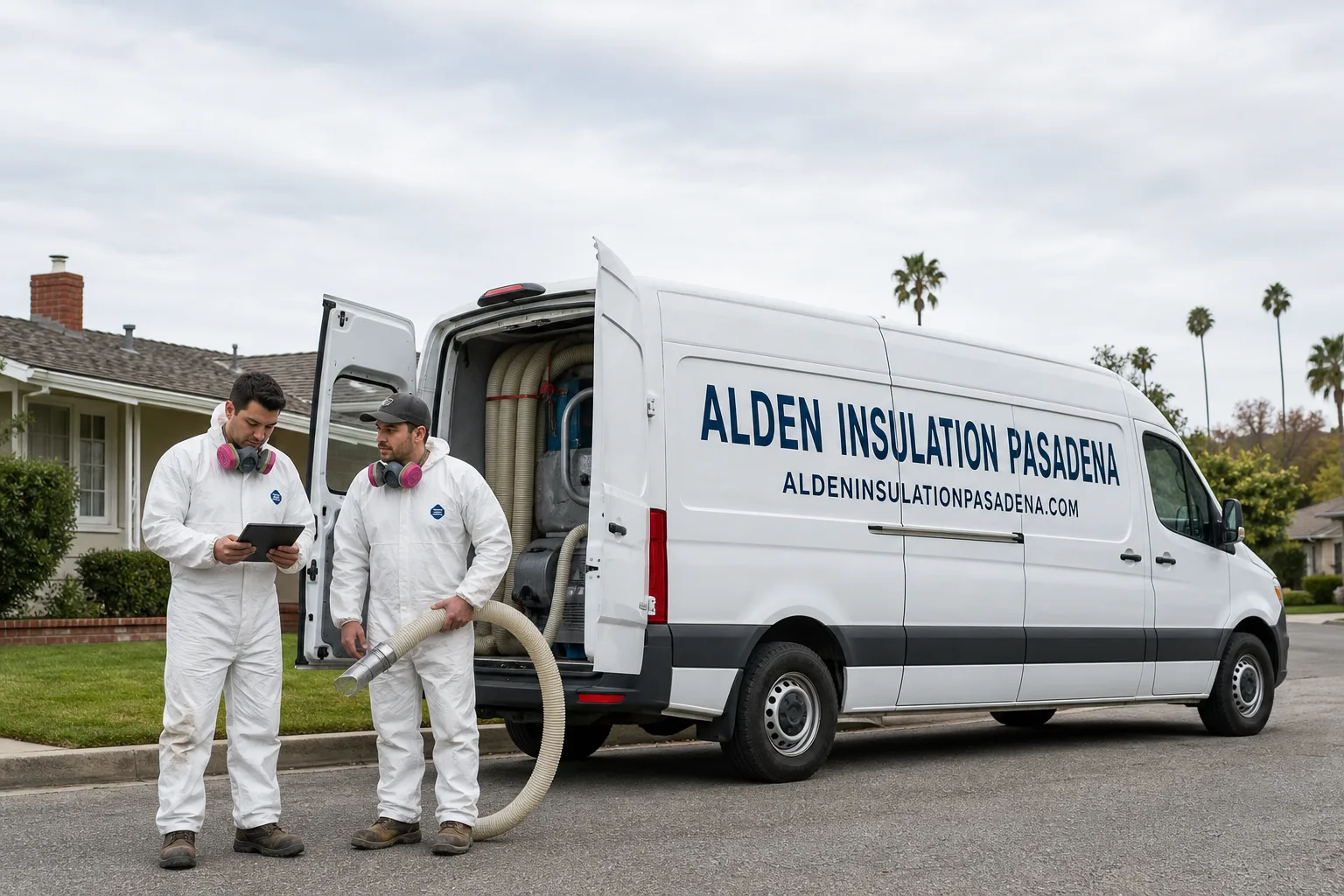
Fast, Reliable Blown In Insulation Across Atwater Village
If your Atwater Village home still has an uninsulated attic, you’re paying for it every month. Most of these 1920s-1940s houses were built with zero attic insulation, and the ones that have some are often working with settled fiberglass that’s lost most of its R-value. We install and remove blown-in insulation across Atwater Village, including homes near Glendale Boulevard, the Los Angeles River bike path, and the hillside streets off Fletcher Drive. Our crews arrive in uniform, background-checked, and the price we quote is the price you pay. Call (626) 628-2368 for a free estimate, any day of the week.
Why Alden Insulation Pasadena Is Atwater Village’s Preferred Blown In Insulation Company
Atwater Village homeowners keep calling us for one reason: we treat an attic like it’s our own. Our technicians know what they’re walking into on a 1932 stucco bungalow off Chevy Chase Drive or a storybook cottage near Glenfeliz Boulevard. We’ve seen the exposed knob-and-tube wiring, the uneven joist spacing, the plaster cracks that let conditioned air leak out. That’s local knowledge you don’t get from a generic contractor.
Alden Attic Insulation is part of the Garrison Partners family, founded in 2002. Every job we run in Atwater Village operates under The Garrison Standard: written prices before work starts, written guarantees for 365 days, and background-checked technicians who show up inside the window they promised. Bryce Holloway leads the team, and he holds every technician to the same bar. If the work fails within a year, we come back at no charge. That’s the 365-Day Done Right Promise, and it applies to every attic we touch in Atwater Village.
Calls are answered by a live person, 24/7. Not a voicemail. Not a callback form. When an Atwater Village homeowner calls at 6 a.m. because they felt a draft all night, a real human picks up.
Blown In Fiberglass Insulation in Atwater Village
Blown In Fiberglass Insulation is the most common retrofit we install in Atwater Village attics. It involves blowing loose fiberglass fibers through a hose into the attic cavity, filling the gaps and covering the joists to a consistent depth. For most homes in the 90039 ZIP code, that means bringing an attic from R-0 or R-11 up to R-38, which is what the Department of Energy recommends for this climate zone. A typical blown-in fiberglass job in Atwater Village runs $1,500 to $3,200 depending on square footage and current R-value.
Filling an Empty 1930s Attic
When we open the access hatch on a 1930s Spanish-style home near Glendale Boulevard, there’s often nothing but exposed rafters and maybe a few batts shoved into one corner. We begin with air sealing: can lights, plumbing penetrations, the attic hatch itself. Then we blow fiberglass to a uniform depth. In Atwater Village’s hot, dry attics, that depth matters. Fiberglass that’s uneven or sparse doesn’t just look bad; it lets heat pour through the ceiling in August.
Re-topping Settled Insulation
Older Atwater Village homes that got insulated in the 1980s or 1990s often have settled fiberglass that’s lost a third of its R-value. We can add a fresh layer on top to restore performance without a full removal. The price for a re-top runs $900 to $1,800 in most Atwater Village attics, depending on how much material is needed.
Loose Fill Insulation in Atwater Village
Loose Fill Insulation refers to any insulation material that’s blown or poured into place rather than rolled out in batts. In Atwater Village, we install loose fill fiberglass from Owens Corning, Johns Manville, and Knauf, and we also work with cellulose from GreenFiber when a homeowner prefers a denser, more sound-deadening option. Loose fill works especially well in the irregular framing common to 1920s-1940s construction, where joist spacing isn’t always a tidy 16 inches on center.
Air Sealing Before Loose Fill
This is where Atwater Village homes need more attention than newer builds. Old plaster walls and original recessed fixtures create air pathways that pull hot attic air down into living spaces, even after the insulation is in. We seal bypasses first, then blow. Skip the sealing and you’ll still get stuffy rooms in July, even with fresh insulation overhead.
Knob-and-Tube Wiring Considerations
Many Atwater Village attics still have original knob-and-tube wiring from the 1920s-1940s. Loose fill insulation cannot be blown directly over live knob-and-tube connections; it creates a fire risk that home inspectors will flag. Our crews build protective channels around the wiring before blowing, keeping the conductors clear and the attic safe. This is a nuance that matters here more than in nearby Glendale or Los Feliz, where housing stock skews newer.
Trusted Brands We Service in Atwater Village
We install products from Owens Corning, Johns Manville, Knauf, Rockwool, and other brands homeowners can research independently before making a decision. For Atwater Village homes with older framing and tight attic access, we often recommend Owens Corning AttiCat blown-in fiberglass; it flows well around irregular joists and holds its R-value in hot, dry conditions. Johns Manville and Knauf blown-in products are also excellent choices depending on the homeowner’s priorities: sound control, fire resistance, or cost per R-value. We don’t push one brand. We show you the options, the written price for each, and let you decide.
Common Blown In Insulation Problems We See in Atwater Village Homes
- Settled fiberglass losing R-value in hot attics. Atwater Village attics routinely hit 120°F in summer, and fiberglass installed decades ago has often settled unevenly. That means cold spots in winter and heat bleeding in during August.
- Insulation blown over knob-and-tube wiring by previous contractors. This is a fire hazard and a home-sale red flag. We see it regularly in houses near Glenfeliz Boulevard and Glendale Boulevard, and we correct it before adding new material.
- No air sealing, so rooms stay stuffy despite insulation. Old plaster cracks and unsealed recessed lights let hot attic air pull through. Insulation alone won’t fix that; the bypasses have to be sealed first.
- Uneven coverage over irregular 1920s-1940s framing. When joist spacing varies, a sloppy blow-in leaves thin patches that show up as warm ceilings on an infrared camera. We check depth with a gauge, not a guess.
Pricing for Blown In Insulation in Atwater Village, CA
Most blown-in attic insulation projects in Atwater Village run $1,500 to $3,200 for a standard single-story home, depending on square footage and the current R-value. A straight re-top over settled insulation is typically $900 to $1,800. Add air sealing and knob-and-tube shielding, and the total lands in the $2,000 to $4,500 range for older homes like the Spanish-style and storybook cottages throughout 90039. Every quote is written, itemized, and locked before work starts. Call (626) 628-2368 and we’ll schedule a free attic inspection, usually within a day or two.
We Also Serve Cities Near Atwater Village
Our crews handle blown-in insulation work throughout the northeast Los Angeles area, including Blown In Insulation work in Pasadena, Glendale, Alhambra, and Pico Rivera. If you’re just outside Atwater Village, Atwater Village is the heart of our service map and we can usually reach nearby neighborhoods the same week a quote is approved.
Serving Atwater Village, CA - Our Local Coverage Area
We’re based in the Atwater Village area and know this community well. Use the map below to see our service coverage - if you’re nearby, we can almost certainly help.
FAQs About Blown In Insulation in Atwater Village
Yes, but only with the wiring properly shielded first. We build protective channels around exposed knob-and-tube conductors, then blow insulation around them without touching the wiring. This is a standard part of our process on older Atwater Village homes, and it’s why a generic contractor who doesn’t know 90039 housing stock can get this wrong. Call (626) 628-2368 for an assessment, and we’ll tell you exactly what your attic needs.
For Atwater Village’s climate zone, R-38 is the recommended attic level, which works out to roughly 10-14 inches of blown-in fiberglass depending on the product. Most older homes here are sitting at R-0 to R-11, so the gap is significant. Getting to R-38 makes a measurable difference in how hard your AC works from June through September.
Yes, and that’s one of the most common complaints we hear from bungalow owners near Fletcher Drive and Glendale Boulevard. Uneven room temps usually come from thin or missing insulation over certain rooms plus unsealed air bypasses. When we blow to a uniform R-38 and seal the leaks, the temperature difference between rooms typically tightens up within days.
Not always. If the old insulation is dry and free of rodent contamination, we can blow new material directly on top. If it’s damp, moldy, or packed with debris from decades of Atwater Village attic dust, removal comes first. We’ll tell you which path your attic needs during the free inspection, and the written price will reflect that before any work begins.
Most Atwater Village homes sit on raised foundations, and cold air from those crawlspaces rises through floor gaps during winter cold snaps. Blowing insulation into the crawlspace rim joists and floor cavity stops that air movement at the source. It also helps keep the floors from feeling like ice on January mornings. Call (626) 628-2368 and we’ll give you a written price for the exact square footage involved.
Ready to fix that attic? Call Alden Insulation Pasadena at (626) 628-2368. A live person answers, we’ll schedule a free inspection in Atwater Village, and you’ll have a written price in your hand before any work begins. If you’ve been putting this off because you don’t trust contractors to show up or honor their word, this is the crew that does both. In writing, guaranteed for 365 days.
Written by Bryce Holloway, Owner at Alden Insulation Pasadena, serving Atwater Village and surrounding communities.