
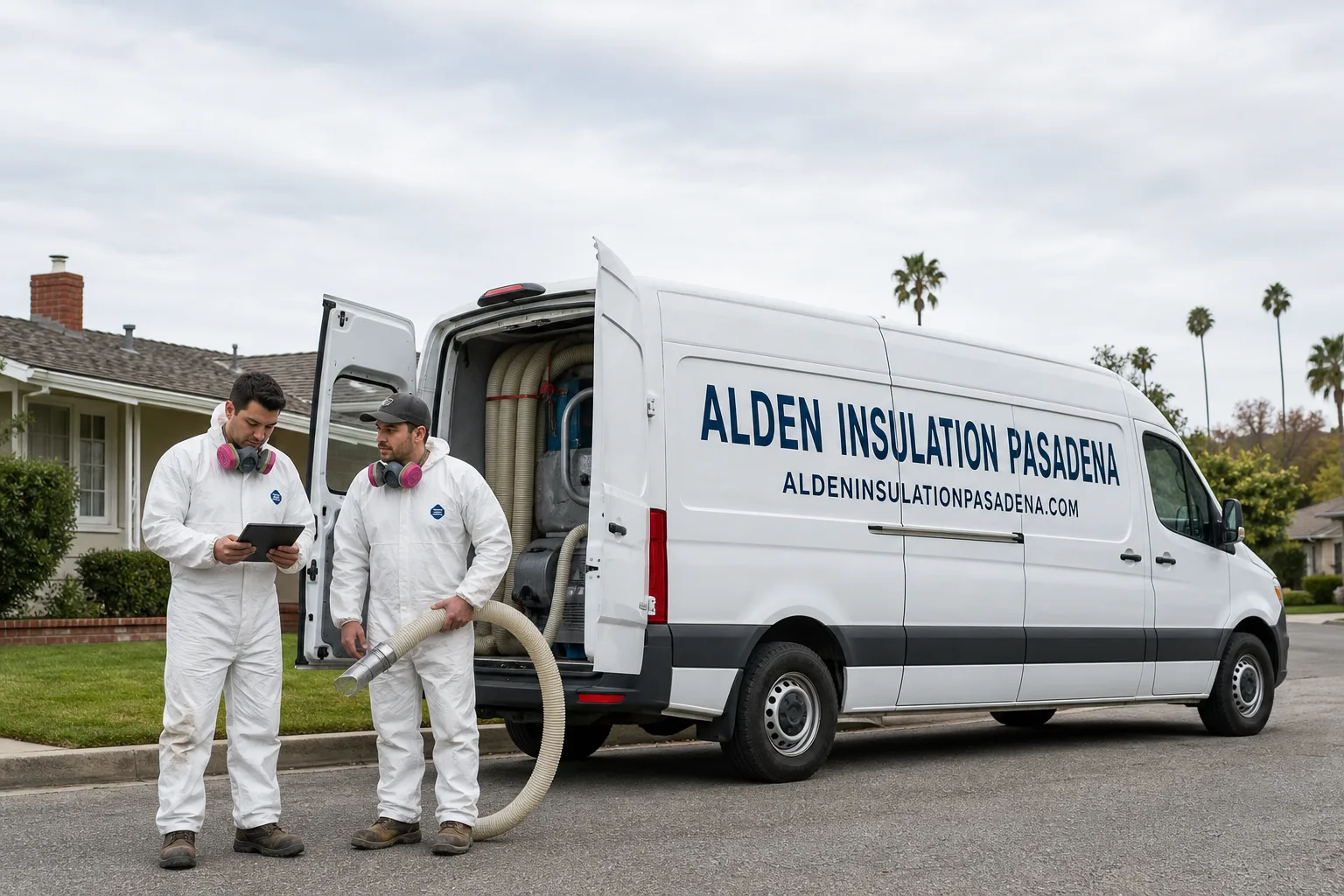
Fast, Reliable Blown In Insulation Across San Marino
Blown in insulation in San Marino generally costs between $1.80 and $4.20 per square foot installed, depending on the material and the condition of the existing attic or wall cavities. For a typical 1,800 square foot attic, most homeowners spend $3,200 to $6,800. The real question in San Marino is rarely the price. It’s whether the crew understands what they’re working with: 90 year old plaster, landmark rules, and architecture that deserves better than a rushed job. We’ve been working in homes across San Marino long enough to know the difference. Call (626) 628-2368 for a written estimate before any work begins.
Why Alden Insulation Pasadena Is San Marino’s Preferred Blown In Insulation Company
San Marino homeowners tend to ask sharper questions than most. They want to know the R-value before you start, what happens to the plaster, and whether the work is reversible. That fits how we operate. Alden Insulation Pasadena is independently owned and operated, held to The Garrison Standard, which means a written price before work starts and a written guarantee good for 365 days. The 365-Day Done Right Promise covers every job we do in San Marino. If the insulation fails within that year, we return at no charge. No re-quoting, no debate.
Our technicians are background-checked and arrive in uniform inside the scheduled window, not a vague half-day range. Calls are answered by a live person 24/7. When a San Marino homeowner calls about an attic that’s running hot in July, someone picks up the phone and can schedule from the Los Angeles office within minutes. Crews serve San Marino locally, so response times are measured in hours, not days.
Bryce Holloway runs the team. He set the standard for how we handle older homes: inspect first, explain what we found, then give you a number in writing. No pressure, no same-day upsell.
Blown In Attic Insulation in San Marino
Blown In Attic Insulation is the most common upgrade we perform in San Marino, and for good reason. Homes built between 1920 and 1960 often have thin batts or nothing more than loose fill that’s settled to half its original depth. An attic with R-19 when the Department of Energy recommends R-30 to R-38 for Southern California is leaking conditioned air all year. We remove what’s failed, air seal the attic floor, and blow in fresh material to the correct depth. Most San Marino attic projects run $3,000 to $6,500 depending on square footage and current R-value.
Air Sealing Before the Blow
Skipping air sealing is the most common mistake we see in San Marino attics. Recessed lights, plumbing penetrations, and gaps around the chimney let conditioned air escape even with thick insulation above them. Our crews seal those gaps with foam and caulk before a single bag of insulation is opened. The insulation works better and the house stops drafting.
Ventilation First in Older Roof Assemblies
San Marino’s warm-summer Mediterranean climate means attics can hit 140 degrees in August. Without proper soffit and ridge ventilation, blown-in fiberglass settles faster and loses R-value as heat and moisture build. We check the venting on every job, and if it’s short of what the roof needs, we tell you before we quote. Fixing ventilation after the insulation is in is costly and disruptive.
Blown In Cellulose Insulation in San Marino
Blown In Cellulose Insulation is the material we recommend for most wall retrofit work in San Marino, especially in the Period Revival homes south of Huntington Drive and up into the estates near Lacy Park. Cellulose is dense, it fills odd wall cavities well, and it doesn’t exert the same outward pressure on lath-and-plaster that can crack a wall during installation. Expect to pay $2.20 to $3.80 per square foot for dense-pack cellulose in San Marino, with most wall projects landing between $4,000 and $9,000.
Dense-Pack for Lath-and-Plaster Walls
Here’s the problem with blowing insulation into a 1930s Spanish Colonial Revival wall: the plaster is often keyed directly to wood lath with no sheathing behind it. Blow too aggressively and the plaster cracks or falls away from the lath. We use dense-pack cellulose from GreenFiber, injected through small access holes at low pressure. It fills the cavity completely without stressing the plaster.
Access Points That Don’t Disturb the Room
On a 1930s Spanish Colonial Revival estate south of Huntington Drive, our crew found uninsulated lath-and-plaster walls with original wood wainscoting. We specified dense-pack cellulose, injected through small, discreet access holes drilled in closets and behind crown molding, avoiding any visible disruption and preserving the historic plaster. That’s the standard on every wall job in San Marino: find the least visible path, protect the finish, leave the room cleaner than we found it.
Trusted Brands We Service in San Marino
We install and remove insulation using products from eight industry-respected brands, including Owens Corning, Johns Manville, Knauf, and Rockwool. That means you can research exactly what goes into your attic before you say yes. We stock materials for San Marino jobs at our local yard, so if you need a specific product or a follow-up visit, we’re not waiting on a distributor three states away. Fast turnaround, written specs, and no mystery materials.
Common Blown In Insulation Problems We See in San Marino Homes
- Cracked plaster from careless blowing. Homes predating 1960 have lath-and-plaster walls that crack when loose-fill insulation is blown at too high a pressure. We see this most often when a previous contractor treated the job like a modern drywall house. Dense-pack cellulose at controlled pressure solves it.
- Settled fiberglass in attics. San Marino’s hot, dry summers bake attics and cause blown-in fiberglass to settle, sometimes losing 30% of its R-value in the first decade. Poor ventilation makes it worse by trapping heat and moisture. We remove the old material and start clean.
- Moisture behind stucco affecting cellulose. In minimally insulated Period Revival homes, stucco exteriors can wick moisture into wall cavities. If that moisture reaches newly installed blown-in cellulose, it creates a mold risk. We inspect for signs of water intrusion before insulating and flag what we find.
- Uninsulated wall cavities in landmark homes. Many San Marino estates built in the 1920s and 1930s have empty wall cavities. Homeowners don’t notice until a room won’t hold temperature or the energy bills climb. Dense-pack cellulose fills those cavities without requiring demolition.
Pricing for Blown In Insulation in San Marino, CA
Blown in insulation in San Marino runs $1.80 to $4.20 per square foot installed. Attic projects land between $3,000 and $6,500 for most homes; wall retrofits with dense-pack cellulose run $4,000 to $9,000. What moves the number: square footage, current insulation depth, access, and whether air sealing or ventilation work is needed. You’ll get a written price before any work starts. The number you approve is the number on the invoice. Call (626) 628-2368 to schedule a free estimate in San Marino.
We Also Serve Cities Near San Marino
Our crews work throughout the San Gabriel Valley. Beyond San Marino, we regularly serve San Marino neighbors in San Gabriel, Alhambra, Pasadena, and Temple City. Same crews, same written guarantee, same 365-Day Done Right Promise on every job.
Serving San Marino, CA - Our Local Coverage Area
We’re based in the San Marino area and know this community well. Use the map below to see our service coverage - if you’re nearby, we can almost certainly help.
FAQs About Blown In Insulation in San Marino
No, if the crew uses dense-pack cellulose at controlled pressure and drills access points in closets or behind trim rather than through visible wall surfaces. Yes, if the crew uses high-pressure fiberglass and treats the wall like modern drywall. The material and the method both matter. We specify dense-pack for every lath-and-plaster wall in San Marino. Call (626) 628-2368 for an evaluation.
San Marino has no demolition permits for contributing structures in its landmark districts, but insulation work itself typically doesn’t require a permit since it’s not structural alteration. However, the installation must be reversible and must not damage original plaster, woodwork, or historic materials. We document the access points and materials used so you have a record if the city or a future buyer asks about the work.
Yes. Dense-pack cellulose is the preferred retrofit material for historic walls because it fills cavities through small holes and doesn’t require removing paneling, trim, or wainscoting. We’ve installed it in English Tudor and Spanish Colonial homes throughout San Marino, including the historic estates south of Huntington Drive, without disturbing original finishes.
San Marino’s warm-summer Mediterranean climate means attics cook in July and August, which causes blown-in fiberglass to settle faster if the attic isn’t ventilated properly. Heat and moisture both reduce R-value over time. We check ventilation on every job and recommend the correct depth for Southern California conditions, typically R-30 to R-38 for attics in this area.
Yes. We drill small access holes in closets, behind crown molding, or in other concealed locations, then blow dense-pack cellulose into the wall cavities. The paneling stays in place. We’ve done this on Tudor homes across San Marino, including several with original wood wainscoting and decorative plasterwork.
Written by Bryce Holloway, Owner at Alden Insulation Pasadena, serving San Marino and the San Gabriel Valley. Part of the Garrison Partners family since 2002.